
Every month a small business owner asks me some version of the same question: where should I put my next advertising dollar?
Google? Facebook? Instagram? Yelp? TikTok? Local Services Ads?
There’s somebody willing to sell you every one of them, and they all have a compelling reason why their platform should get your money.
But if you’re a local service business spending $300, $500, or maybe $800 a month, most advertising advice was written for somebody with a much bigger budget.
At your budget, the answer gets a lot narrower.
Start where people are already looking for what you sell.
Then make sure you can tell whether it actually worked.
Intent beats interruption when money is tight
The easiest way to think about advertising channels is intent versus interruption.
Someone searching Google for “therapist near me,” “emergency plumber,” “divorce lawyer Orange County,” or “house cleaner Irvine” is actively trying to solve a problem.
They’re looking.
Someone scrolling Instagram or Facebook may be a perfect potential customer, but they weren’t necessarily looking for you at that moment. Your ad interrupted whatever they were doing.
That doesn’t make Facebook or Instagram bad advertising. Far from it. Meta can be excellent for awareness, retargeting, offers, visual businesses, and generating demand.
But when you’ve only got $300 to $800 to work with, I’d rather start by putting you in front of the person already raising their hand.
That’s why Google Search and, where available, Google’s Local Services advertising usually belong near the top of the list for local service businesses.
Before spending another dollar, check three things
This part isn’t exciting, but it can matter more than which advertising platform you choose.
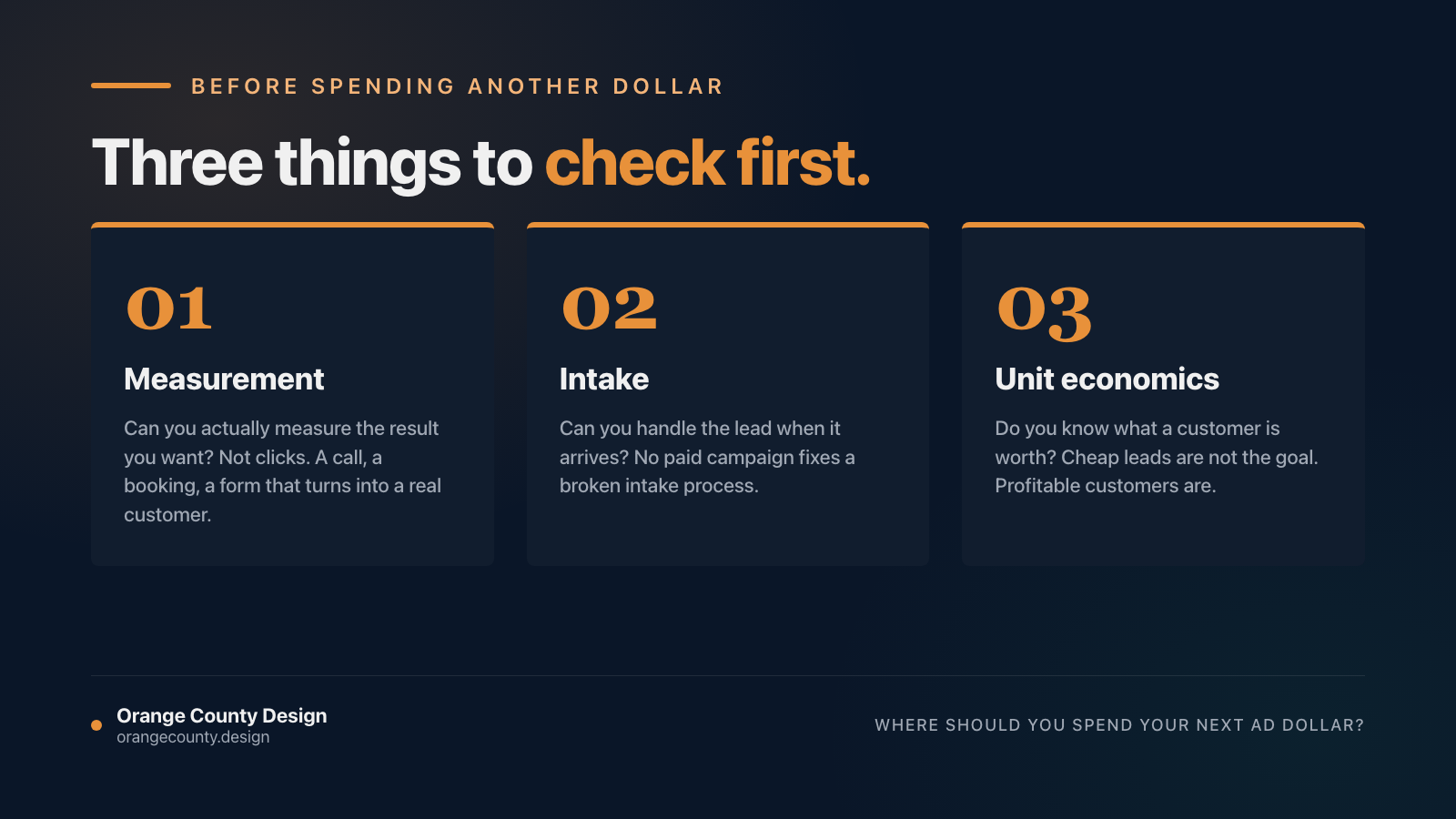
Can you actually measure the result you want?
Don’t tell me the goal is “more traffic.”
What do you actually want somebody to do?
Call you? Book an appointment? Request an estimate? Submit a consultation form? Walk into the store?
Pick the action that gets somebody meaningfully closer to becoming a customer.
Then make sure it can be measured.
Once you know what action matters, make sure you can actually tell when it happens and where the lead came from.
If someone clicks an ad and then calls you, books an appointment, or submits a form, that action should be recorded.
Don’t assume your tracking works just because somebody installed Google Analytics or a Meta Pixel two years ago.
Test it.
Submit the form. Make the call. Book the appointment. Then verify that it shows up where it’s supposed to.
The tools behind this might include Google Analytics, Google Ads, the Meta Pixel, or Meta’s Conversions API. You don’t need to obsess over the plumbing. The important part is knowing that when your advertising produces a real lead, you can see it..
Can you handle the lead when it arrives?
I see businesses spend hours adjusting campaigns while ignoring the person who already contacted them.
If someone calls and nobody answers, what happens?
If they fill out a form at 2:15 in the afternoon, when does somebody respond?
If you’re a contractor standing on somebody’s roof, that’s understandable. But you still need a process.
That might be someone answering the phone. It might be an answering service. It might be an AI receptionist. It might simply be an immediate text saying, “I’m on a job right now. I received your request and I’ll call you within 15 minutes.”
The exact system matters less than having one.
Google itself tells Local Services advertisers to respond consistently to calls and messages and notes that repeatedly failing to respond can affect ad ranking.
If you can’t reasonably handle another 20 leads this month, don’t buy 20 more leads.
Do you know what a customer is worth?
This is where a lot of small-business advertising gets fuzzy.
Ask an owner what a normal customer is worth and you’ll often hear:
“Well, it depends…”
Of course it depends. Come up with a reasonable average.
You need at least three numbers:
Advertising spend ÷ qualified leads = cost per qualified lead
Advertising spend ÷ new customers = cost to acquire a customer
Revenue from those customers ÷ advertising spend = return on ad spend
The middle number is the one small service businesses often ignore.
Suppose one campaign produces leads at a cost of $20 each and another produces leads at $60 each.
The $20 leads look fantastic on the advertising dashboard.
But if twenty $20 ($400 total) leads produce one customer while five $60 ($300) leads produce two customers, the supposedly “expensive” leads are actually making you more money.
If you don’t know what happened after the form was submitted, you’re only measuring half the system.
So where should the first $300 to $800 actually go?
If you’re starting from scratch, I would work down this ladder.
First: Google Local Services advertising, if you’re eligible
For many local service businesses, Google’s Local Services advertising is about as close as you can get to the thing we’re looking for: somebody searches for a service, sees local providers, and contacts one.
Google currently supports a long list of eligible businesses including plumbers, electricians, HVAC contractors, lawyers, cleaners, therapists and other healthcare providers, tax services, real estate services, tutors, auto repair businesses, and many others. Availability varies by category and location.
Unlike conventional search advertising, Local Services uses a pay-per-lead model rather than charging for every click.
Something to note on 2026 note: Google is moving some Local Services advertisers into a newer campaign setup. If you’re in an affected category, you may see the name “Performance Max” appear in your account.
Don’t let the name confuse you. For these Local Services campaigns, the basic idea remains the same: they are designed to generate local service leads and continue to use a pay-per-lead model.
So if your account suddenly looks different, it doesn’t necessarily mean your advertising strategy changed. Google may simply have changed how the campaign is managed behind the scenes.
Second: Google Search
If Local Services isn’t available for your business, or you want more control over what you’re targeting, Google Search is usually where I’d look next.
This is the classic intent play.
Someone types what they need.
You pay to compete for that search.
But a $500 Google Ads campaign should not look like a $50,000 campaign shrunk down.
Keep it tight.
Don’t advertise every service you offer. Start with the service you most want to sell.
Don’t target half the state. Start with the geographic area you can actually serve profitably.
Don’t dump 150 loosely related keywords into one campaign. Focus on searches that strongly suggest somebody is trying to hire someone.
Don’t send every visitor to your homepage just because it’s your homepage. Send them to a page that directly addresses what they searched for and gives them an obvious way to contact you.
And watch the actual search terms people use.
If you’re paying for searches that clearly have nothing to do with becoming a customer, exclude them.
At $300 a month, every stupid click matters.
What about Facebook and Instagram?
Use them.
Just don’t automatically use them first.
If Google is already generating profitable customers, my first question usually isn’t, “What other platform should we add?”
It’s:
Can we profitably put another $100 into what’s already working?
That’s an important distinction.
Small businesses often diversify their advertising too early. They finally get one thing working and immediately split the budget again.
If your $500 Google campaign is producing profitable work and there’s room for more demand, try $600 before taking $100 away and starting an entirely new experiment.
Meta starts becoming more interesting when you have something to work with.
You have meaningful website traffic.
You have people who visited but didn’t contact you.
You have a good customer list.
You have an offer that works visually or emotionally.
Or you’ve captured as much high-intent demand as you reasonably can and now want to create more of it.
That’s when interruption advertising starts earning more of the budget.
What I’d do with a small monthly budget
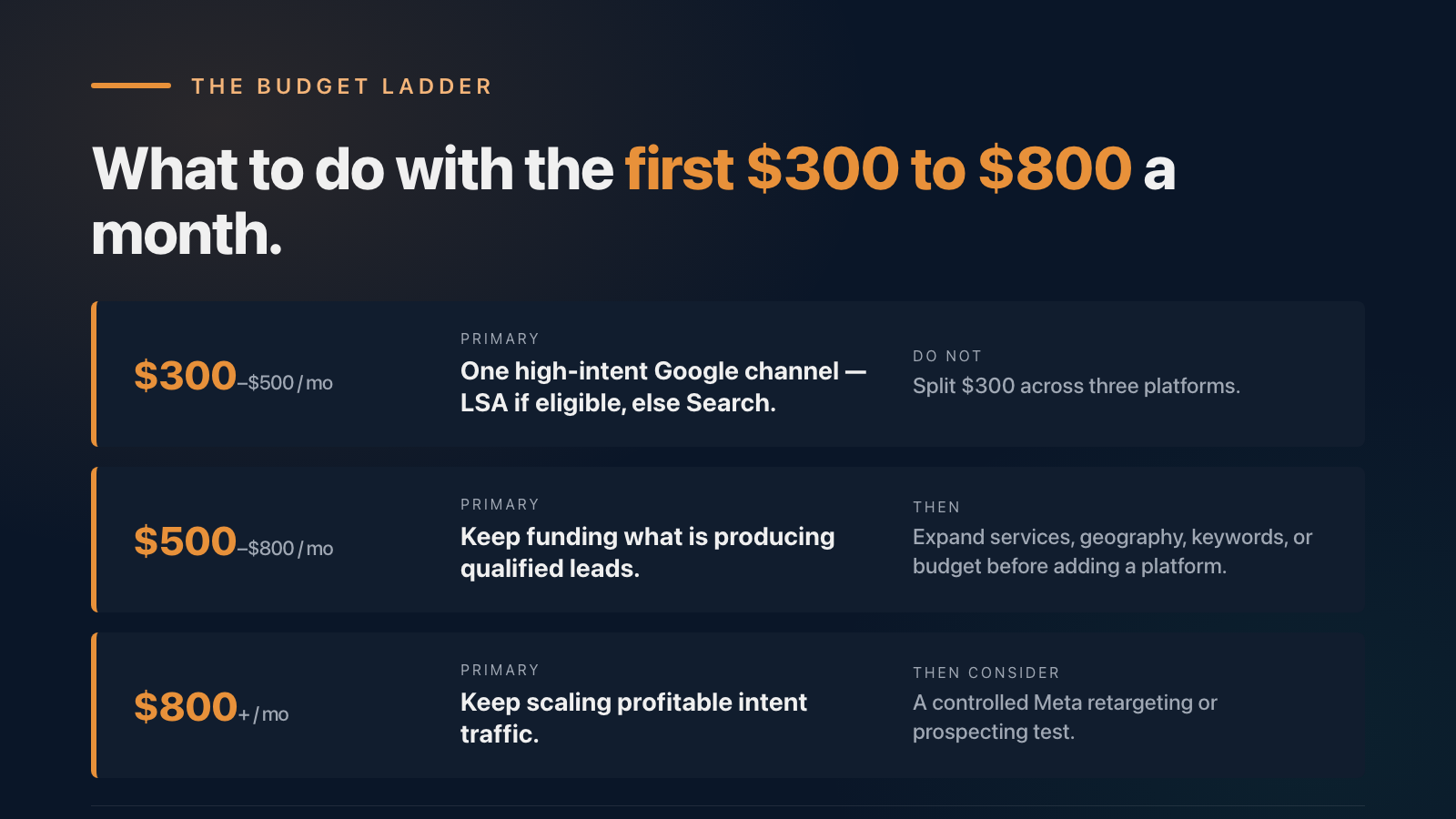
| Monthly ad budget | What I’d do |
|---|---|
| $300–$500 | Pick one high-intent Google channel. Local Services if eligible and appropriate, otherwise a tightly focused Search campaign. Do not split $300 across three platforms. |
| $500–$800 | Keep funding the channel that is producing qualified leads and customers. Expand services, geography, keywords, or budget carefully before adding another platform. |
| $800+ after something is working | Continue scaling profitable intent traffic. Then consider a controlled Meta retargeting or prospecting test if you have enough traffic, audience, and tracking to learn something useful. |
There is no prize for advertising on more platforms.
One campaign that produces five profitable customers is worth more than four dashboards full of impressions.
If you’re already spending money and getting nothing, don’t immediately spend more
This is probably the most important part of this article.
If you’re already spending $300, $500, or $800 every month and can’t tell me what happened to the money, don’t increase the budget yet.
Find the leak.
Start with the last 30 to 90 days and answer these questions:
How much did you spend?
How many real inquiries did you receive?
Where did they come from?
How many were qualified?
How many booked?
How many became paying customers?
What did those customers buy?
If you can’t answer those questions, that’s the first problem to solve.
Maybe the advertising is bad.
But maybe the ads are generating calls that nobody tracks.
Maybe forms are coming in but aren’t being answered quickly.
Maybe Google Ads is counting a button click as a conversion even though the person never submitted anything.
Maybe your campaign is generating leads perfectly well but half of them want a service you don’t provide.
Maybe your $40 leads are actually profitable and you’ve been turning the campaign off because somebody told you that leads in your industry should cost $25.
You won’t know until the advertising data and the actual customer data meet each other.
Three mistakes that burn small advertising budgets
Chasing the cheapest cost per lead
A platform showing you cheap leads doesn’t mean it is producing cheap customers.
Follow the lead all the way through the sale.
Letting automation optimize the wrong thing
Google and Meta have become very good at automated optimization.
But the system still needs to know what success means.
If you tell an advertising platform that every form submission is valuable, it will try to find more form submissions.
It doesn’t magically know that twelve of them were spam, four wanted jobs, two lived outside your service area, and only one became a customer.
The closer the signal you send back gets to an actual qualified lead, booked appointment, completed job, or revenue event, the more useful the optimization becomes.
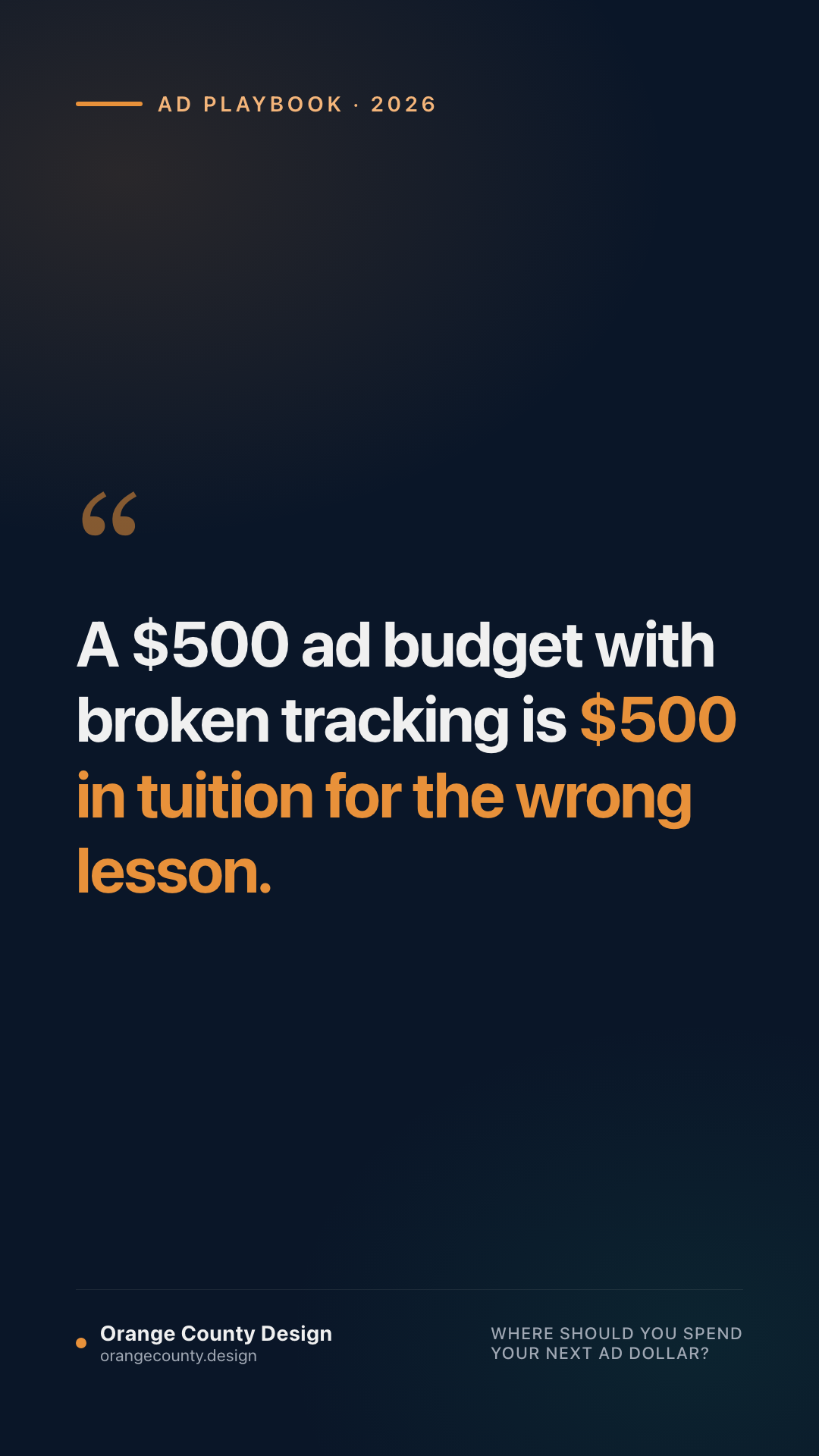
Skipping tracking because “we’re only spending $500”
That’s exactly when tracking matters.
A company spending $50,000 can survive a few stupid decisions while it figures things out.
Your $500 campaign cannot.
You probably need fewer ads, not more
If you’ve got a limited budget, you can skip a lot of things.
You can skip TikTok because somebody told you everybody is on TikTok.
You can skip running Google, Facebook, Instagram, Yelp and Microsoft Ads simultaneously.
You can skip the agency package that promises to “manage your presence everywhere” while spreading a few hundred dollars so thin that no individual channel gets enough attention to teach you anything.
You can even stop advertising temporarily if your tracking and intake are broken.
Fix the foundation.
Then find the place where customers are already looking for you.
Put enough money there to learn something.
Measure what happens after the click.
Answer the phone.
Track the customer through the sale.
Then, when something works, put the next dollar there too.
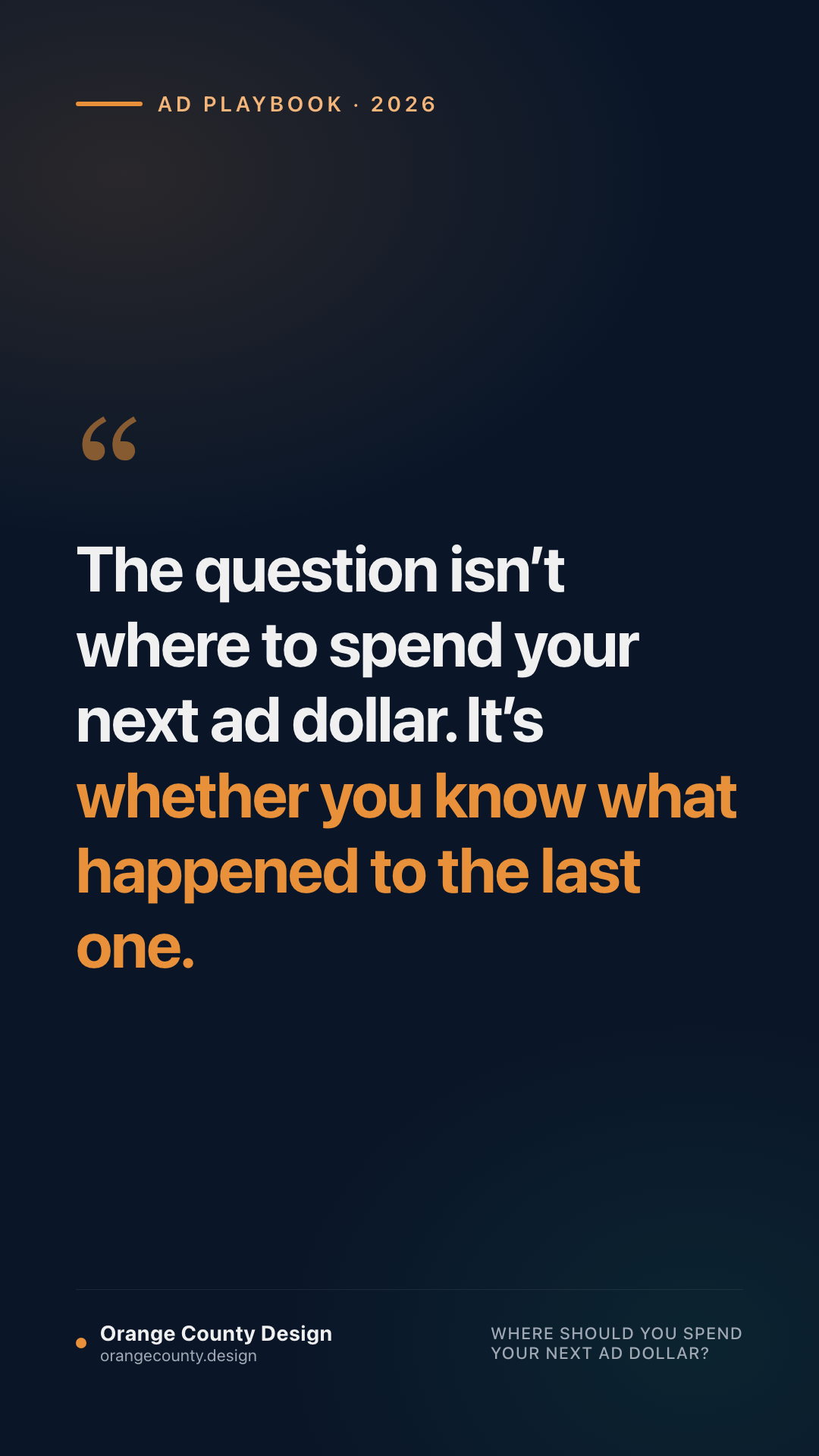
The question isn’t really where to spend your next ad dollar.
It’s whether you know what happened to the last one.
Want a second opinion on where your ad dollars are going?
The Ads and Tracking Audit is a fixed-scope review of your current spend, conversion tracking, and platform mix, with a written plan for what to change next.