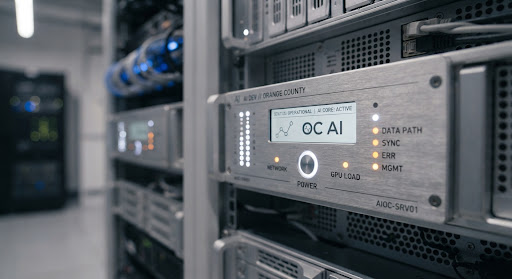
Autonomous Agents
Custom multi-agent systems designed to handle complex, multi-step reasoning tasks, accelerating architectural drafting and research.
Orange County Design builds bespoke, high-performance AI systems designed to solve complex architectural and operational challenges. Strategy first, execution precise.
Starting Engagement
$50,000 / custom build
The AI development practice focuses on three core pillars designed to integrate seamlessly into high-end enterprise workflows.
Custom multi-agent systems designed to handle complex, multi-step reasoning tasks, accelerating architectural drafting and research.
Retrieval-Augmented Generation systems that securely index and query proprietary firm data.
Orange County Design integrates top-tier foundational models — OpenAI, Anthropic, open-source — directly into existing software stacks, ensuring security, compliance, and zero latency.
Production-grade AI
The model works on five test prompts. The founder is impressed. The team builds a Slack thread of more prompts that worked. The build never ships — because nobody addressed the boring parts: how the data gets in, how the model gets evaluated, what happens when the API rate-limits, how cost scales when ten users become a thousand.
Orange County Design takes AI past the demo. Into the codebase. Into the workflow. Into the bill it generates and the time it saves.
Custom AI Agents
Claude, GPT, open-source models. Single-turn or multi-step. Tool-using. Memory-aware.
RAG Pipelines
Proper chunking, hybrid retrieval, retrieval evaluation. Not a vanilla embeddings demo.
LLM Integration
Slack bots, internal copilots, customer-facing assistants, and automated processing pipelines wired to existing infrastructure.
Evals + Observability
The part most teams skip and regret. Production AI without evals is a coin flip. Every deployment ships with documented evaluation criteria.
Cost Optimization
Prompt caching and model routing. Same output, lower spend. Often cuts costs 60–80% on production workloads.
How it works
Get started
Every custom AI build begins with Discovery + Scoping. Advisory blocks cover architecture reviews, technical planning, and AI strategy without committing to a full build.
AI Discovery + Scoping
Starting at $2,500
Two-week paid discovery that produces a written specification, milestone plan, and fixed-bid quote. Credited toward the full build.
Advisory Block — 4 hours
$1,000
Four hours of senior advisory time, bookable in 30-minute increments over 60 days. Architecture, AI strategy, technical planning, or troubleshooting.
Advisory Session, 1 hour
$295
For advisory sessions and time-boxed consulting, the rate is $225/hr. Longer engagements are fixed-fee or weekly-billed, never hourly.
Start with Discovery + Scoping. Orange County Design scopes, specifies, and builds — no demos, no ambiguity.